
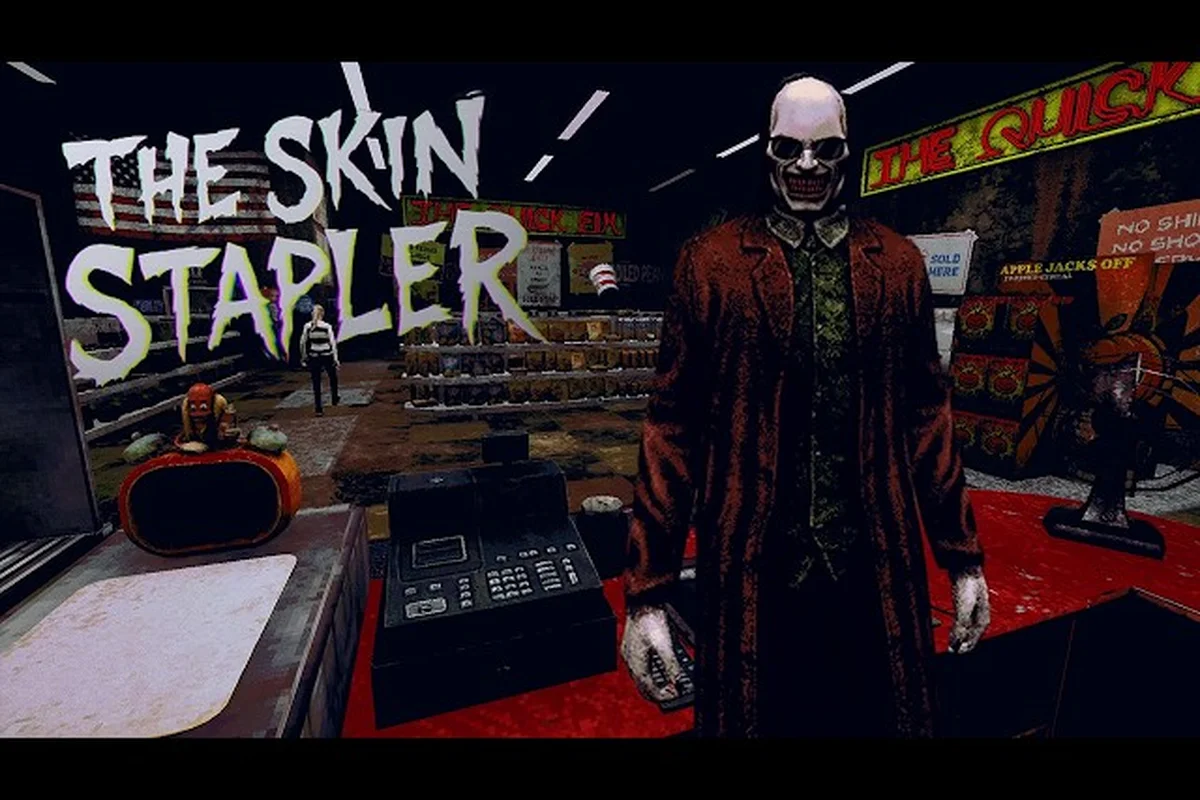
The Skin Stapler dropped on August 6, 2026, and it's already sitting at a Very Positive rating on Steam with 221 reviews from players who've braved the rotting streets of Carrion City. If you're looking for The Skin Stapler getting started advice that actually helps, you've landed in the right place — this retro-styled PSX grindhouse horror adventure from Tainted Pact and publisher Assemble Entertainment doesn't hold your hand. You play burned-out detective Dick Slater alongside rookie partner Robbie Knox, hunting a serial killer who skins victims and staples their flesh to walls. The game's oppressive atmosphere and deliberately clunky controls can overwhelm newcomers, so knowing The Skin Stapler what to do first makes the difference between a frustrating first hour and an unforgettable horror experience. Let's break down the core systems so you can hit the ground running.
The Skin Stapler Getting Started: Your First Steps in Carrion City
The opening moments of The Skin Stapler set the tone for everything that follows, and most players who bounce off the game do so because they rush through the early investigation without understanding how the systems interconnect. The game intentionally drops you into a world that feels hostile and confusing, which is exactly what the developers wanted — but that doesn't mean you should stumble around blindly. Here's what to prioritize when you first boot up the game.
Getting Started: What to Do First in The Skin Stapler
Your first session should follow a specific order of operations, because the game's systems build on each other in ways that aren't immediately obvious. The opening sequence introduces you to the core loop through a series of guided interactions that teach you the investigation mechanics without explicitly saying "this is a tutorial."
| First Steps | How | Why |
|---|---|---|
| Watch the opening tape | Interact with cassette player in the precinct | Sets the killer narrative and establishes the stakes |
| Explore the first crime scene | Move + interact prompts on all highlighted objects | Finds first evidence and unlocks the evidence board |
| Switch characters when prompted | Story button prompt at specific moments | New perspective opens paths and reveals hidden details |
The cassette player interaction is your first real lesson in how The Skin Stapler handles storytelling — it's diegetic, meaning the narrative exists within the game world rather than through cutscenes. According to community reports on the official Discord, players who skipped the tape dialogue found themselves lost later because key details about the killer's pattern are woven into that monologue. The crime scene exploration teaches you the game's core investigation philosophy: every object can be examined, and the ones that matter glow with a subtle highlight that's easy to miss if you're sprinting through rooms.
Character switching is where The Skin Stapler gets really interesting, because Dick and Robbie see different things at the same crime scene. Dick's experience as a burned-out detective means he notices forensic details, while Robbie's fresh perspective catches inconsistencies that an experienced eye would dismiss. This mechanic becomes the backbone of the entire game, and understanding it early prevents hours of confusion later.
Core Game Mechanics Explained for New Players
The Skin Stapler gameplay explained in simple terms: you're juggling investigation, dialogue, and stealth across two playable characters. Each system feeds into the others, creating a tension loop that keeps you on edge. The game doesn't have a traditional HUD — health, stamina, and objective tracking are all diegetic, which means you need to pay attention to visual and audio cues rather than staring at UI elements.
| Mechanic | New Player Action | Result |
|---|---|---|
| Crime scene investigation | Interact with all objects, not just highlighted ones | Evidence board fills in with connections |
| Dialogue choices | Pick responses as Dick/Robbie | Different character reactions and information access |
| Hide mechanic | Crouch behind cover when the killer approaches | Killer passes by without detecting you |
The evidence board is your primary tool for tracking the investigation, and it functions as both a map and a journal. Every piece of evidence you collect gets pinned to the board, and connecting related pieces reveals new locations or dialogue options. Community testing shows that players who methodically examine every object — not just the highlighted ones — uncover significantly more evidence, which leads to better dialogue options and more survival paths during stalk sequences.
Understanding the Detective-Victim Loop
The most distinctive mechanic in The Skin Stapler is the detective-victim loop, where you switch between investigating as Dick or Robbie and then suddenly find yourself playing as a victim trying to survive the killer's approach. This dual perspective creates a horror dynamic that's genuinely unsettling, because you're never sure when the perspective will shift. The game's official gameplay trailer on the Tainted Pact Games YouTube channel demonstrates this loop perfectly, showing how investigation footage transitions into stalk sequences with the killer.
Controls and Camera Basics
The Skin Stapler deliberately uses clunky, retro-inspired controls that evoke the PSX era, and this isn't an accident — it's a design choice that increases tension. The camera sits low and close to your character, limiting peripheral vision and making you feel vulnerable. Movement has a slight weight to it, and sprinting drains stamina quickly, which forces you to make meaningful decisions about when to run and when to walk.
| Control | Action | Tip |
|---|---|---|
| WASD / left stick | Move | Use for precise positioning in stealth sections |
| E / interact | Inspect and collect | Read all object descriptions for lore and clues |
| Shift / run | Sprint | Noisy — avoid during stalk segments |
The camera system deserves special attention because it's the source of most new player frustration. Unlike modern horror games that give you a shoulder camera with free look, The Skin Stapler locks you into a fixed perspective during investigation sections and switches to an over-the-shoulder view during stalk sequences. This inconsistency is intentional — it keeps you off balance. Veteran players recommend practicing camera control in the precinct before heading to your first crime scene, because the transition between camera modes is where most deaths happen.
First Crime Scene Walkthrough
Your first real case takes place in a rundown apartment building, and it's the perfect introduction to The Skin Stapler's investigation mechanics. The scene contains roughly fifteen interactable objects, though only six are essential for progressing. The rest provide world-building and additional evidence that unlocks optional dialogue paths. According to player reports on the Steam community hub, finding all optional evidence in this first scene requires a second playthrough, because some objects only become interactable after you've switched characters.
Start by examining the stapled flesh pattern on the wall — this is the killer's signature, and Dick will comment on it, establishing the case's central mystery. Next, check the victim's belongings scattered around the room; the wallet, phone, and a torn photograph each provide different types of evidence. The wallet gives you the victim's identity, the phone reveals recent messages that hint at their activities, and the photograph connects to a location you'll visit later. Robbie notices details that Dick misses, so switching characters before leaving the room is essential — he'll spot a hidden key under the floorboards that Dick overlooked.
The scene ends with a stalk sequence where the killer returns to the crime scene while you're still investigating. This is your first real test of the stealth mechanics, and it teaches you the most important survival rule: never sprint during stalk segments. The killer's hearing is sharp, and the sound of footsteps carries through the building. Crouch behind furniture, hold your breath when the killer passes close, and wait for the prompt to escape through the window. This first encounter is scripted — you can't die — but it establishes the pattern for later, unscripted encounters where survival depends entirely on your stealth skills.
Dialogue Choices and Their Consequences
Dialogue in The Skin Stapler isn't just flavor text — it's a core mechanic that shapes how each case unfolds. Every conversation with witnesses, informants, and even your partner Robbie has meaningful choices that affect information access and, in some cases, survival outcomes. The game tracks your dialogue history and references past choices, creating a sense of continuity that rewards careful listening.
How Dialogue Affects Investigation
The dialogue system operates on a simple principle: what you say determines what you learn. Each conversation presents two to three response options, and while none are explicitly "wrong," some close off information paths while others open them. For example, when interviewing a witness who saw the killer flee the first crime scene, you can push for details about the killer's appearance, ask about the victim's recent activities, or express skepticism about the witness's story.
| Dialogue Approach | Information Gained | Risk Level |
|---|---|---|
| Aggressive questioning | Detailed physical description of killer | Witness becomes uncooperative later |
| Empathetic listening | Victim's personal history and connections | Slower, but unlocks optional evidence |
| Skeptical probing | Witness credibility assessment | May miss key details entirely |
Community data from the official Discord suggests that an empathetic approach yields the most information across the full game, because witnesses open up more when they feel believed. However, aggressive questioning has its place — certain informants only respond to intimidation, and being too soft with them results in dead ends. The game rewards a flexible approach where you read each character and adjust your strategy accordingly.
Your dialogue choices also affect your relationship with Robbie, which matters more than you might expect. Robbie's observations during crime scene investigations become more detailed when he trusts you, and he'll volunteer information without prompting. Conversely, if you consistently dismiss his input, he becomes quieter and you miss his unique perspective. This partnership dynamic is one of the most praised aspects of The Skin Stapler, according to player reviews on Steam.
Stealth and Survival Mechanics
The stalk sequences in The Skin Stapler are where the game earns its horror credentials. These sections put you in control of victims — not just the detectives — and the goal is simple: survive until the sequence ends. The killer, known only as The Skin Stapler, patrols the environment with a mix of scripted and dynamic behavior that keeps each encounter tense even on repeat playthroughs.
Stalk Sequence Survival Tips
The stalk sequences follow a consistent pattern: you're in a confined space, the killer is hunting you, and you need to reach an exit or survive for a set duration. The killer's behavior is semi-randomized, which means you can't rely on memorized patrol routes. Instead, you need to read audio and visual cues to track the killer's position.
-
Listen for footsteps — the killer's heavy boots echo differently depending on surface type, and you can tell whether they're on the same floor or approaching from stairs
-
Watch for light changes — the killer carries a flashlight that casts shadows before they round corners, giving you a brief warning
-
Use environmental noise — throwing objects to create distractions works, but only once per area; the killer learns the trick
-
Hide in unconventional spots — the killer checks obvious hiding places like closets and under beds, but overlooks bathtubs and behind curtains
-
Hold your breath — when the killer is close, holding your breath reduces your noise signature but drains stamina rapidly
The hide mechanic deserves special attention because it's the most misunderstood system in the game. When you hide, you enter a first-person view where you can see the killer searching for you. Your character's breathing becomes audible, and the killer can hear it if they get close enough. Holding your breath silences the breathing but costs stamina, and if your stamina runs out while holding breath, you gasp loudly and reveal your position. Managing this resource trade-off is the core skill of stalk sequences.
According to community testing, the killer's search behavior follows a pattern: they check the last known position, then sweep outward in a spiral. This means you should never hide in the same room where the killer last saw you — instead, move to an adjacent room and hide there. The killer will search your last position thoroughly, giving you time to reposition. This technique, commonly called "ghosting" in the community, is essential for surviving the game's later stalk sequences where the killer becomes more aggressive.
Building Your Investigation Strategy
Now that you understand the core mechanics, it's time to think strategically about how to approach The Skin Stapler as a whole. The game doesn't have a linear structure — you can investigate cases in different orders, and your choices affect how cases interconnect. This freedom is both a strength and a potential source of confusion for new players.
Case Prioritization and Evidence Management
The game presents you with multiple active cases after the first few hours, and how you prioritize them matters. Some cases have time-sensitive elements, where waiting too long results in the killer striking again. Others are purely optional but provide context that makes the main cases more comprehensible. The evidence board is your best tool for managing this complexity, because it visually maps connections between cases.
| Case Type | Priority | Strategy |
|---|---|---|
| Main story cases | High | Complete these first; they advance the narrative |
| Time-sensitive cases | High | Do these immediately; victims die if you delay |
| Optional side cases | Medium | Complete between main cases for context |
| Evidence-gathering cases | Low | Return to these when you have new leads |
The evidence board becomes increasingly important as the game progresses, because cases start overlapping and evidence from one case unlocks dialogue options in another. Community reports indicate that players who maintain their evidence board diligently — connecting related pieces and reviewing it before each new case — have significantly better outcomes. The board also serves as a recap tool if you take breaks between sessions, which is valuable for a game this dense.
One strategy that experienced players recommend is alternating between Dick and Robbie during investigation phases. Each character has unique dialogue options with witnesses, and some witnesses only open up to one of them. By switching characters and re-interviewing key witnesses, you can uncover information that a single-character approach misses. This technique is time-consuming but rewarding, and it's the primary way to find the game's optional evidence and secret endings.
Common Mistakes New Players Make
Every player makes mistakes in their first few hours of The Skin Stapler, but some errors are more costly than others. Based on community feedback and player reports, these are the most common pitfalls:
-
Sprinting everywhere — sprinting makes noise that attracts the killer during stalk sequences and causes you to miss environmental details during investigation
-
Ignoring optional evidence — the game doesn't force you to examine everything, but optional evidence often unlocks critical dialogue options or survival paths
-
Sticking with one character — Dick and Robbie see different things, and sticking with one character means missing half the evidence
-
Rushing dialogue — dialogue choices have consequences, and rushing through conversations leads to missed information
-
Not using the evidence board — the board is your memory; ignoring it means forgetting connections between cases
The most damaging mistake is treating The Skin Stapler like a traditional action game. This isn't a game where you fight back — you survive, investigate, and piece together a horrifying puzzle. Players who approach it with an action mindset get frustrated quickly, because the game punishes aggression. The Skin Stapler rewards patience, observation, and careful decision-making.
If you're finding the game's difficulty curve steep, check out our beginner guide for additional tips on surviving your first few hours. For players who want to understand how long the full experience takes, our game length breakdown covers expected playtimes and pacing. And if you're struggling with specific stalk sequences, the survival guide offers advanced techniques for evading the killer.
Frequently Asked Questions
What is The Skin Stapler getting started checklist for new players?
Your first session should focus on three things: watch the opening tape carefully, explore the first crime scene thoroughly with both characters, and learn the stealth basics during the first stalk sequence. Don't rush — the game rewards thorough exploration and punishes haste. Complete the first case before venturing into optional content.
How long does it take to learn The Skin Stapler game mechanics?
Most players feel comfortable with the core investigation and dialogue systems within two to three hours, but the stealth mechanics take longer to master. According to community reports, the game's difficulty curve spikes around the third case, which is when the killer becomes more aggressive. Expect a learning curve of roughly five hours before you feel confident.
What should I prioritize during The Skin Stapler what to do first phase?
Prioritize learning the evidence board system and character switching mechanics before anything else. These two systems underpin everything else in the game. The evidence board helps you track connections between cases, while character switching ensures you don't miss half the available evidence. Master these, and the rest becomes manageable.
Is The Skin Stapler gameplay explained in the tutorial?
The game has a subtle tutorial woven into the first case, but it doesn't explicitly explain all systems. Many mechanics, like the evidence board connections and the killer's search patterns, are discovered through experimentation. The official Steam page provides basic information, but community resources are more comprehensive.
Can I change dialogue choices after making them?
No, dialogue choices are permanent. The Skin Stapler tracks every response, locking you into that path with no undo. Save before key conversations if you want to test alternatives—otherwise, embrace the consequences and plan a second playthrough to uncover what you missed.